The construction and operation of hydroelectric and other dams on the Columbia River and throughout the natural resource use area of the Yakama Nation has had devastating impacts to the Yakama people and our treaty-reserved natural resources. Diligently working to improve hydro system operations and water management in these areas will aid in rebuilding aquatic species populations. The Yakama Nation’s advocacy of actions such as improving fish passage so that all species are taken into account, reducing dam passage mortality, and managing flows to improve fish survival and transport to the ocean helps create a more natural river, benefiting all native species.
Federal Columbia River Power System
The Federal Columbia River Power System (FCRPS) provides approximately one third of all the electricity for the Pacific Northwest. The FCRPS provides a navigation and commerce route for freighters and other vessels from the Pacific Ocean to Lewiston, Idaho, and provides flood control throughout the length of the Columbia River. Within FCRPS, a total of 31 hydroelectric projects are operated by the U.S. Army Corps of Engineers and the Bureau of Reclamation. The Bonneville Power Administration markets the power produced by these dams and implements mitigation programs to offset the detrimental impact of the system on natural resources.
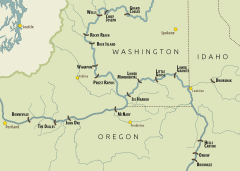
The Biological Opinion (BiOp) for the Columbia River System Operations covers the immediate and long-term actions related to the configuration, operation, and maintenance of the 14 major dams that are part of the FCRPS. These include Bonneville, The Dalles, John Day, McNary, Chief Joseph, Grand Coulee, Albeni Falls, Libby, Hungry Horse, Ice Harbor, Little Goose, Lower Monumental, Lower Granite, and Dworshak dams (Figure 6).
The Northwest Power and Conservation Council has estimated that the Columbia River hydropower dams are responsible for between 5 and 11 million salmon and steelhead every year; 80% of all losses in the Columbia River Basin.
Mid-Columbia Public Utility District Hydroelectric Facilities and Agreements
Habitat Conservation Plans (HCPs), referred to collectively as the Mid-Columbia HCPs, were developed to help address effects of three hydropower projects covering more than 100 river miles on the mainstem of the mid-Columbia River. These plans developed for Douglas County Public Utility District’s (PUD) Wells Hydroelectric Project and Chelan County PUD’s Rocky Reach and Rock Island projects were finalized in 2002, although the YN did not initially sign the agreements. The YN signed the HCPs three years later in 2005. The PUDs worked cooperatively with state and federal fisheries agencies, three Indian Tribes, and an environmental organization to develop these first hydropower HCPs for salmon and steelhead. The plans commit the two utilities to a 50-year program to ensure that their projects have no net impact on mid-Columbia salmon and steelhead runs. This is being accomplished through a combination of fish bypass systems, spill, off-site hatchery programs and evaluations, and habitat restoration work in mid-Columbia tributary streams. The YN is a member of the decision-making committees that guide implementation of the terms of the HCPs and mitigation programs at these three projects.
Wanapum and Priest Rapids Settlement Agreement
The Priest Rapids Salmon and Steelhead Settlement Agreement (Wanapum and Priest Rapids dams) was cooperatively developed by Grant County PUD, state and federal fisheries agencies and three tribes (YN, CTUIR, and CCT). The Settlement Agreement is intended to provide a comprehensive and long-term adaptive management program for the protection, mitigation, and enhancement of salmon and steelhead which pass or may be affected by the projects. The Settlement Agreement is intended to provide a comprehensive and long-term adaptive management program for the protection, mitigation, and enhancement of salmon and steelhead which pass or may be affected by the projects.
Other private and public utilities
The Yakama Nation participates in numerous Federal Energy Regulatory Commission (FERC) processes governing energy projects in the Pacific Northwest.